Plant file · Owned by default
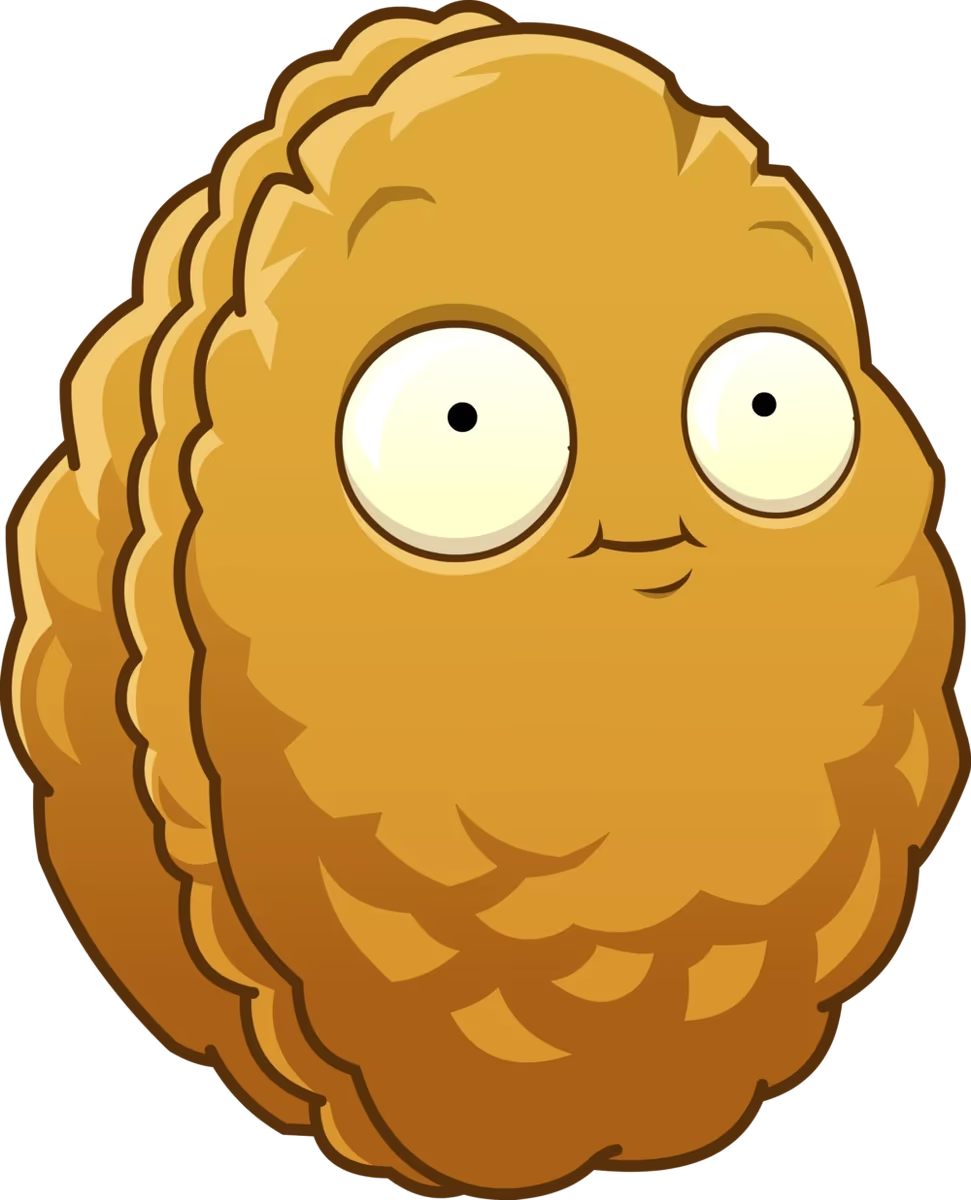
Wall-nut
A high-HP front line that also actively shoves zombies back.
 Sun100
 Recharge50s
 Durability6000
Lore
Wall-nut's reliability extends beyond his shell. Before departure, he researches Maple Falls, knows its autumn scenery, and invites Lily Pad in anticipation of fighting on water. When the others discuss sweets, he is often the one reminding them that zombies are coming.
The dream's exercises reveal a new side of the familiar defender: he can push enemies away himself. A diary suggests that he once retired from a bowling team, much to Homing Thistle's disappointment. Collisions still figure in his life, though he now usually holds his ground for those behind him.
He is remarkably calm about being bitten, comparing it to a relaxing massage. Red Stinger reserves judgment. Alongside his preparations and attention to enemy movements, that composure gives the word dependable more than one meaning.

Mechanics
Role
Defensive wall · Active knockback
Base data: 100 sun; 50s recharge; 6000 HP.
Blocks zombies and absorbs damage to protect plants behind it.
Left-click: spends some HP and knocks the front zombies backward.
Right-click / long-press release: destroys Wall-nut and pushes the front zombies much farther back.
Can specially crossbreed with Peashooter and enter the Pea-nut state.
HP absorbs bites and pays for active knockback. Crossbreeding with Peashooter creates the Pea-nut state, replacing knockback with shooting. 100 cs = 1 second.
Durability, cracks, and repair

At present, normal Wall-nut has a 6000 HP cap, the highest among shipped usable plants. The face shows three HP bands: at or above two thirds of max HP it stays intact; between one third and two thirds it shows the first crack layer; below one third it switches to heavy cracks. For normal Wall-nut, the band thresholds are 4000 HP and 2000 HP. Note: the cracks are only a visual readout of current HP and do not provide extra armor.
Planting a fresh Wall-nut on the tile of an existing one consumes the new plant; its remaining HP is added to the old Wall-nut's current HP, capped at the maximum. The Wiki refers to this as repair planting. The same 100 sun and 50s recharge can therefore either build a new wall or extend an existing one.
Small-shove self-damage, biting, outside healing, and repair planting all refresh the displayed cracks immediately on resolution, so the face works as a quick read of current HP.
Knockback area and costs

By default, on desktop, left-click triggers the small shove, while right-click or releasing a long press triggers the heavy shove; on mobile, a tap and a long press map to the same two actions. Both shoves affect only valid targets inside the hit zone directly in front of Wall-nut. They interrupt bites, push pressure back, or reopen space rather than deal ordinary attack damage. Note: according to the Wiki, the hit zone is a rectangle anchored at Wall-nut's center, 80 px tall and 100 px long; a charmed Wall-nut never triggers either shove.
The small shove pushes hit-zone zombies 80 px backward with a 50 cs knockback animation during which they cannot advance; for each target successfully pushed, Wall-nut loses 150 HP. With N as the number of valid targets actually shoved or interrupted, H'=max(H−150N, 0). In particular, the HP cost resolves once for the whole shove, so even if the nut is reduced to 0 HP or below at some k<N, the remaining N−k targets are still shoved by the same rule; this post-mortem shove does not count toward the “zombies killed plants” tally.
The heavy shove pushes targets 320 px, about 4× the small shove's distance, with the same animation and stun window; Wall-nut dies on resolution regardless of whether anything was actually shoved. That death also does not count toward the “zombies killed plants” tally.
Boundaries and special targets

At the moment of the click, knockback reads target position and state inside the hit-zone. Ordinary zombies travel 80 px (small) or 320 px (heavy) backward; some forced movement, boss contact, or heavy units behave more like a stun window than a fully proportional displacement. Since 0.17j, downed Lantern Imps can also be shoved.
Displacement results are clipped by the field boundary, most visibly for the heavy shove. A Wall-nut placed far back struggles to push targets out of the threat band, while a forward placement converts the same shove into more usable spacing.
Since 0.17f, knockback's vertical (Y axis) effect is separated from the horizontal push: a target shoved over water and falling back in plays an entry/exit splash effect, and the water/land boundary no longer eats the displacement.
Pea-nut state and inheritance

Pea-nut Shooter is not a separate plant; it is Wall-nut's Pea-nut state. When a Peashooter specially crossbreeds with a Wall-nut, Wall-nut does not show the obvious gene flash that normal Peashooter crossbreeding does, but it still enters the Pea-nut state and awards the “Somatic Hybridization” achievement.
On entering the Pea-nut state, max HP increases by 2000 and current HP is immediately restored to the new cap: a normal Wall-nut goes from 6000 to 8000 HP. The Pea-nut state no longer has the small or heavy shove; tile position and runtime state outside HP are preserved.
Pea-nut peas inherit every gene of the donor Peashooter, but the attack parameters are weakened (at least at present). Projectile size is fixed at √2/2 of a normal pea, so per-shot damage halves to 10 normal, 10 ice, and 15 fire. The Bb large-pea gene no longer enlarges Pea-nut peas to √2× size; instead it restores them to normal size. Dd side shots travel a different path than Peashooter's: they first drift to the lane above before returning to the home lane, which should be planned for at edge-lane positions.
Pea-nut repeat fire also differs from Peashooter's. Note: according to the Wiki, the per-volley repeat chance follows the formula below, where n is the number of repeats already made in the current volley. The per-volley extra-shot cap is 2 and, unlike Peashooter's cap, is not affected by the previous volley's repeat count.
Journey notes

The tutorial introduces blocking, small knockback, and large knockback in sequence. Wall-nut also brings early news of Lily Pad and Starcone Zombie.
Dialogue links the hybrid’s origin to the peanut pun. The special crossbreed is associated with the plant somatic hybridization achievement.

Interactions & counters
- Peashooter
Can special-crossbreed with Peashooter into a Pea-nut Shooter.
- Honey Bamboo
Knockback can force targets in and out of bamboo shoots for repeated damage.
- Wheel Zombie
Hard plants can temporarily stop the stone wheel and buy time to separate it from the zombie.
- Hurriclover
Can block the dash and protect plants behind it.

In-game tooltip
Blocks off zombies and protects your other plants. Left-click to make him take some damage and slightly knock zombies back. Right-click to make him self-destruct and greatly knock zombies back.