Plant file · Sands of Time ~ Urgency
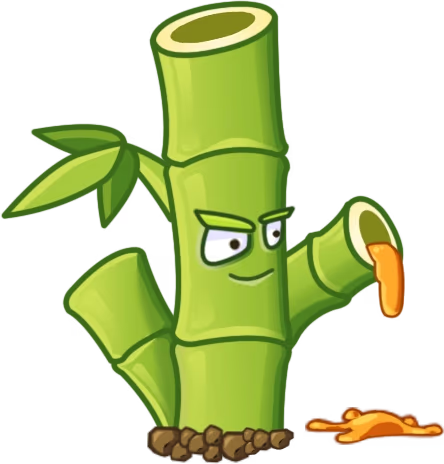
Honey Bamboo
Fragrant by day, rotten by night. Crossing the shoots hurts either way.
 Sun75
Sun75 Recharge30s
 Durability3000
Lore
Honey Bamboo is chief adviser to Alloysuckle's organization, occupied with affairs around the Distant Pond before meeting the team. Hurriclover knows the reputation of someone who helped establish a firm foundation for a local power. The skill becomes apparent in sorting out a problem rather than announcing an arrival.
The adviser gathers clues, asks where information comes from, and considers the conditions before acting. Even a blunt opponent's words can help explain what might happen next. Politeness coexists with resolve, as does a concern that haste could make a difficult situation worse.
Red Stinger enjoys the daytime honeydew, while its nighttime odor recalls rotten eggs. Homing Thistle has experienced another peculiarity: standing among the shoots may feel harmless, but entering and leaving hurts. Even an adviser's immediate surroundings deserve careful attention.

Mechanics
Role
Lane control · Bamboo shoot damage · Honeydew liquid
Base data: 75 sun; 30s recharge; 3000 HP.
Lays a bamboo shoot area in front; targets take damage when entering or leaving it.
Day: fragrant honeydew attracts zombies or plants from adjacent rows into Honey Bamboo's row.
Night: rotten honeydew drives targets in the row to the upper or lower row.
With Wall-nut knockback or other Honey Bamboos, targets can be forced in and out of the shoot area repeatedly.
Shoots deal damage at entry and exit boundaries; honeydew changes movable targets’ lanes. Day and night choose the direction, while containers and smoke can transfer the liquid effect.
Entry, residence, and exit

Entering the forward shoot zone deals a hit; leaving deals another. Remaining inside without crossing again does not generate damage merely over time.
Walking, knockback, and lane changes can all cross boundaries. Each Bamboo owns its zone, and each valid crossing resolves that zone’s entry or exit.
Day/night movement and water limits

Daytime honeydew pulls targets from adjacent lanes into its lane; nighttime corrupt honeydew pushes targets out to adjacent lanes. Board edges, invalid lanes, and immovable states constrain the result.
Since 0.17o, honeydew types do not pull carrier or flying plants; honeydew, corrupt honeydew, and swamp fluid disappear in water. Direction alone does not guarantee a successful lane change.
Knockback and repeated crossings

A target pushed out by Wall-nut after entering crosses the boundary again. Walking or being pulled back in produces another entry check, provided an actual crossing occurs.
Neighboring Bamboo zones may each trigger during one displacement. Movement also changes other plants’ target positions and coverage; it grants no fixed extra damage multiplier.
Honeydew containers and beam paths

Planting Honey Bamboo on CocoBottle Shine fills it with honeydew or corrupt honeydew for the current time state. Bottle breakage, Hygro Plantago absorption, and Opti-caltrop beams read that liquid type.
Hygro Plantago converts honeydew into smoke carrying damage and lane movement alongside other absorbed fluids. A beam carries the bottle’s type into its final hit; another filled bottle replaces that carried type.
Durability and movement limits

Honey Bamboo has 3000 HP and cannot be pulled by Fisherman Gargantuar’s hook. Its honeydew can still move other eligible plants; allegiance alone does not cancel displacement.
A defeated Bamboo no longer supplies honeydew; 0.17o fixed lingering liquid graphics after durability loss. Applayer healing adds only 1 HP to Bamboo and spends all remaining note applications.

Interactions & counters
- CocoBottle Shine
Planting it on the bottle fills the bottle with honeydew or rotten honeydew.
- Wall-nut
Knockback can force targets through bamboo shoots repeatedly.
- Honey Bamboo
Multiple Honey Bamboos can alternate attraction and repulsion to create focus lanes and repeated crossing damage.
- Fisherman Gargantuar
Cannot be pulled by the hook, making it reliable defense.

In-game tooltip
Honey Bamboos lay bamboo shoots in front of them and spread honeydew. Day: fragrant honeydew attracts zombies. Night: rotten honeydew drives zombies away. Zombies take damage when entering or leaving the bamboo shoot area.