Zombie file · Sands of Time ~ Urgency
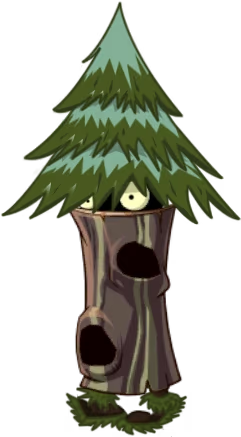
Pine Zombie
Jumps by day, hides by night, and emerges to throw pinecones.
 Durability600–800 by difficulty
 Speedfast during day jumps
Lore
Pine Zombie uses local trees as cover, enough to confuse newcomers. While looking for a member of Alloysuckle's organization, the team briefly considers an agile tree-shaped figure. CD-shroom explains that it is a zombie inside a tree shell, a local hunting adaptation.
Diagonal leaps by day give way to sheltering inside the shell at night. Homing Thistle notes the tree costume and tile-based movement, finding the idea of a plant among zombies almost reasonable. The borrowed shape does not erase the wearer's intentions.
Red Stinger remembers the slippery movement most clearly and even envies the freedom of traveling diagonally. Trees no longer remain safely in the scenery: one can dodge and harass the travelers, making the landscape worth another look.

Mechanics
Role
Day-night dual mode · Evasion and damage reduction
Durability: 600–800 HP by difficulty; fast speed during day jumps.
Day jumps avoid ordinary damage and scan nearby Cherry Bombs and loading CD-shrooms; freezing cannot interrupt a jump in 0.17r.
The night shell caps each valid damage event at 5 HP, but knockback and freezing can affect the shell in 0.17r; exposed throwing disables the cap.
One health pool persists across day and night, without a basic-body critical reserve.
Day jumps avoid hits and the night shell caps individual damage events; both modes share one health pool.
Total HP and shell damage cap

Maximum HP is 600+50L for L∈{0,1,2,3,4}, giving 600–800 HP. Pine Zombie has no basic-body critical reserve; cracks at two-thirds and one-third indicate damage to the same health pool.
The night shell caps each valid damage event at 5 HP. Exposure during throwing or attacking disables the cap without creating a second armor health bar.
Day jumps and attack pauses

By day, outside biting or locked actions, it checks usable tiles and combines forward/backward displacement with lane selection into a diagonal jump. Jump and evade animations avoid ordinary damage; since 0.17r freezing cannot interrupt a jump either. Hit conditions are checked before takeoff and after landing.
A blocking plant can lead to an attack action. Field boundaries, unavailable lanes, and terrain restrict lane changes; an adjacent lane is not always reachable.
Scanning cherries and loading discs

Daytime movement checks recognize nearby Cherry Bombs and loading CD-shrooms as threats and attempt an evade jump.
A threat can still hit during an attack action, without an available adjacent lane, or after landing. Threat scanning is conditional on state and position, not permanent immunity to those plants.
Night hiding and throw exposure

At night it enters a hiding action followed by the shell state. In 0.17r the shell can be knocked back or frozen, and damage to a frozen Pine Zombie no longer triggers retreat. An eligible target ahead leads to an exposed pinecone throw with adjusted trajectory; shell and throwing share one HP pool.
Shell state deducts min(D,5 HP), while exposed throwing restores ordinary damage handling. Without a suitable target or when day/night conditions change, it can move or emerge again.

Interactions & counters
- Cherry Bomb
Attempts to dodge by day; its shell can still be knocked back or frozen.
- CD-shroom
Also avoids loading CD-shroom during the day.
- Plant blockers
Blocking its daytime movement path is effective.