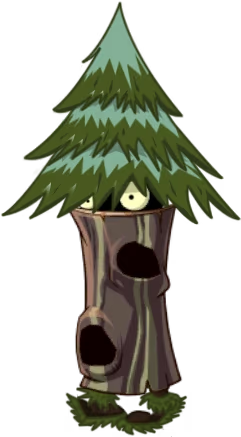
Boss file · Sands of Time, Sand-3-B
Poisson Pine
Past the Fourier Fir, a famous function waits at the sequence limit.
Residue... Resentment
Our snow and ice will not melt for a thousand autumns; our curse will be endless.

Lore
Poisson Pine stands at the end of a sequence of cold trees in the Sands of Time. The travelers already know zombies moving inside tree shells; now the familiar shapes gather around an opponent with a name of its own. Trees cease to be background scenery and occupy the view.
The Chinese naming plays on cold trees and mathematical functions, bringing sequences, limits, and convergence into an apparently solemn introduction. Fourier gives way to Poisson in a wintry grove. The wordplay is light, though facing the assembled trees may be less so.
The group inhabits a region where snow and sand meet, making its wintry appearance especially striking. Shells around bodies and the arrival of more trees give the encounter a lingering chill. Amid the region's shifting conditions, the cold-tree formation seems to hold tightly to the outline of a wintry landscape.

Mechanics
Role
Area miniboss · Cold-tree line core
Appears as the boss at the end of the cold-tree line.
Applies pressure through the tree line, tree summons, and field control.
Version 0.17m strengthened Poisson Pine on high difficulties: shorter startup, shorter summon interval at low health, and a higher summon cap.
Jumping grants damage immunity; shell state converts positive hits to about 5 HP of damage, while exposed landings use normal damage.
Summon activation, population limits, and boss posture use separate checks. Difficulty d ranges from 0 to 4; reinforcement m is 0 or 1. Internal timer units are left unconverted.
HP and summon activation

Main-story maximum HP is 2000(d+5), plus 5000 under reinforcement. Initial summoning normally waits about 10000−2000d internal timer units.
Losing more than 1000 HP before that timer expires also activates summoning. Time and HP loss are alternative activation conditions; active-tree count is still checked afterward.
Cold-tree limit and replenishment

Replenishment requires the active cold-tree count to be below its cap, 2d+2: 2, 4, 6, 8, or 10 from Easy to Unbalanced.
Each summon recalculates the interval within [150(11−d),3600] internal timer units. Higher HP tends toward the longer end and lower HP toward the shorter end. The 0.17m changes included earlier startup, shorter low-HP intervals, and a higher cap.
Exposed, jumping, and shell states

The boss takes no damage while travelling in a jump. Landing and becoming exposed restores normal damage handling; position and vulnerability are separate properties.
In the compressed shell state, each positive hit becomes approximately 5 HP of chip damage, capped by remaining HP. Shell, jump, and exposed states have distinct damage rules; summoned cold trees remain separate objects.